

The Role of the Private Sector in Nigeria’s Food Security Agenda
Adeola Oke
Insights
31st Oct 2025

In 2022, the Cadre Harmonisé report revealed that food insecurity in Nigeria had reached alarming levels, with about 55.8 million people struggling to access enough food and 19.5 million facing acute hunger.
Food insecurity is not just about food not being available to people. It touches every part of the agricultural value chain. Farmers face limited access to quality inputs, credit, and markets. Consumers face high food prices, and businesses struggle with unstable supply chains. This circle keeps both farmers and consumers vulnerable. Food security, on the other hand, is not just about producing more food. It’s about building sustainable systems that ensure access, affordability, and resilience.
Despite being a major agricultural producer in Africa, Nigeria’s productivity still lags compared to that of other countries. According to An Overview of Federal Government Programs by Rasaq Oyeleke (2024), Nigeria’s crop yields for key staples such as wheat, rice, and maize remain far below those of China, India, Brazil, and Mexico. This productivity gap highlights one of the most significant challenges in achieving food security: low agricultural efficiency and limited adoption of technology.
Over the years, Nigeria has implemented several agricultural programs aimed at improving food production and reducing hunger. Some notable examples include:
Operation Feed the Nation (1976–1979): Launched to encourage Nigerians to grow their own food and reduce dependence on imports.
Green Revolution (1980–1983): Focused on boosting agricultural productivity through mechanization and improved seedlings.
National Fadama Development Project (1993–2019): Supported smallholder farmers through irrigation and access to resources.
Anchor Borrowers’ Program (2015–present): Designed by the Central Bank of Nigeria (CBN) to provide credit to smallholder farmers linked to agro-processors.
National Agricultural Technology and Innovation Policy (2022–2027): Aimed at modernizing agriculture through technology and private sector collaboration.
While these government-led programs show commitment, factors such as funding constraints, infrastructure gaps, and inconsistent implementation have limited their long-term impact. To build a truly food-secure nation, Nigeria needs efficient collaboration with the private sector.
At Crop2Cash, our work demonstrates the tangible impact of private sector innovation on smallholder livelihoods. To date, we have served over 500,000 farmers across 700+ local government areas, helping them access digital payments, markets, and advisory support through our ecosystem of products. More than 70% of farmers on our platform report an increase in income, while yields have grown by 35% through access to climate-smart inputs and better farm practices.
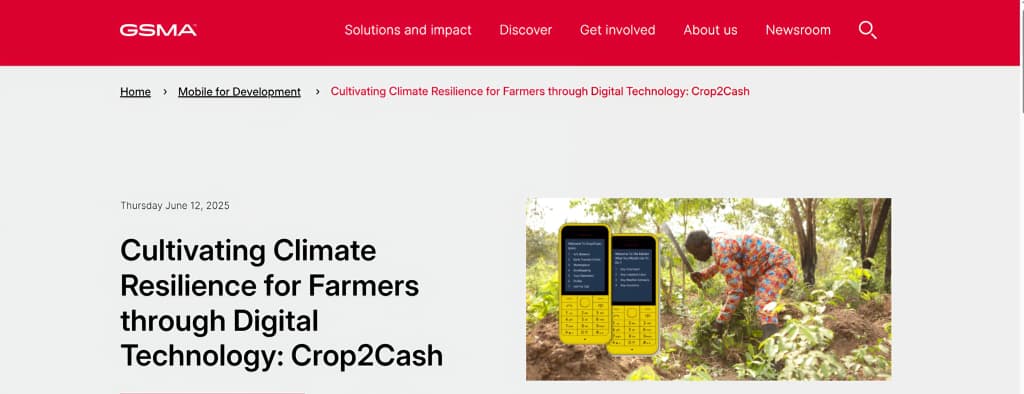
Our impact was recently highlighted in a GSMA case study titled “Cultivating Climate Resilience for Farmers through Digital Technology,” which explores how our digital tools are helping farmers adapt to climate challenges and build resilient food systems.
The Role of the Private Sector in Strengthening Nigeria’s Food System
While government-led agricultural initiatives have provided a foundation for growth, the scale of Nigeria’s food security challenge demands deeper private sector participation. The private sector plays a pivotal role in mobilizing capital, driving innovation, and building sustainable systems that ensure food is not only available but also accessible and affordable.
Bridging the Investment Gap
Public funding alone cannot meet the growing financial needs of Nigeria’s agricultural sector. The private sector can fill this gap by channeling investments into critical areas such as mechanization, irrigation, logistics, and digital agriculture. From agritech startups offering access to finance to impact investors funding climate-smart farming, private initiatives are proving that agriculture can be both profitable and sustainable. Companies like Crop2Cash demonstrate how private investments can empower farmers through digital wallets, marketplace access, and real-time advisory services, directly improving productivity and financial inclusion.
Strengthening the Agricultural Value Chain
One of the primary contributors to food insecurity is post-harvest loss, often resulting from inadequate storage, limited processing capacity, and weak logistics. Private companies are helping close these gaps by investing in aggregation centers, cold storage facilities, and efficient transport networks that move produce from farms to markets faster and fresher. By building stronger value chains, the private sector reduces waste, stabilizes prices, and ensures that both farmers and consumers benefit.
Creating Employment and Empowering Communities
Beyond production, private sector participation drives employment across the value chain, from input distribution to processing, packaging, and retail. It also provides economic opportunities for women and youth, who make up a significant portion of Nigeria’s agricultural workforce. By enabling entrepreneurship and equitable participation, private-led initiatives directly support the Sustainable Development Goals (SDGs), particularly SDG 1 (No Poverty), SDG 2 (Zero Hunger), SDG 5 (Gender Equality), and SDG 8 (Decent Work and Economic Growth).
Driving Innovation and Technology Adoption
Across Africa, private-led innovations are redefining what’s possible in agriculture, and Nigeria is no exception. Through mobile-based financial tools, AI-driven advisory services, and data platforms, private enterprises are bridging the gap between technology and the realities of smallholder farmers. For example, digital wallets and USSD services make it easier for farmers to save, pay, and access credit without internet access. At the same time, AI-powered tools like the National Hotline for Agriculture (NHFA) provide instant advisory support in local languages.

During a chat with the TechCabal team, our Co-Founder recently spoke about how we choose accessibility over sophistication every time at Crop2Cash.
Image Credit: TechCabal
Policy Support and Collaboration
For the private sector to thrive, an enabling policy environment is essential. This includes incentives for agritech innovation, grants, improved infrastructure, and transparent regulations that encourage investment. Public-private partnerships (PPPs) offer a powerful framework for scaling impact, combining government reach with private efficiency. Collaboration, rather than isolated efforts, will determine how quickly Nigeria can achieve lasting food security.
Crop2Cash continues to collaborate with development partners and institutions, including the GSMA, FCMB, and Mastercard Foundation, aligning private innovation with public goals to scale sustainable food systems across Nigeria and Africa.
Bottom Line
The path to a food-secure Nigeria lies in combining public ambition with private innovation. With the right policies and partnerships, we can ensure that no farmer is left behind and no household goes hungry.
At Crop2Cash, we believe the future of food security lies in partnership and innovation. Together, we can grow a stronger, more food-secure Nigeria.
Share this post
Comments
Contact Us
hello@crop2cash.com.ngOffice
19A, Dejo Oyelese Cl, Mokola Hill, Ibadan 200285, Oyo State
Kaduna Technology City, Off Makama, Beside Living Faith Church, Gidan Gona Barnawa, Kaduna State



Crop2Cash - Grow it, Cash it.
Copyright © 2026 All rights reserved. Crop2Cash